Legal education in India is a prestigious and structured field governed by the Bar Council of India (BCI), the apex regulatory body. It aims to produce competent legal professionals who can serve the judiciary, corporate sector, government, and society. The system offers a wide range of programs, from undergraduate degrees to doctoral research, catering to diverse career aspirations and academic interests. The quality and recognition of these programs are often reflected in rankings like the National Institutional Ranking Framework (NIRF).
Jorhat Law College Fee Structure 2026
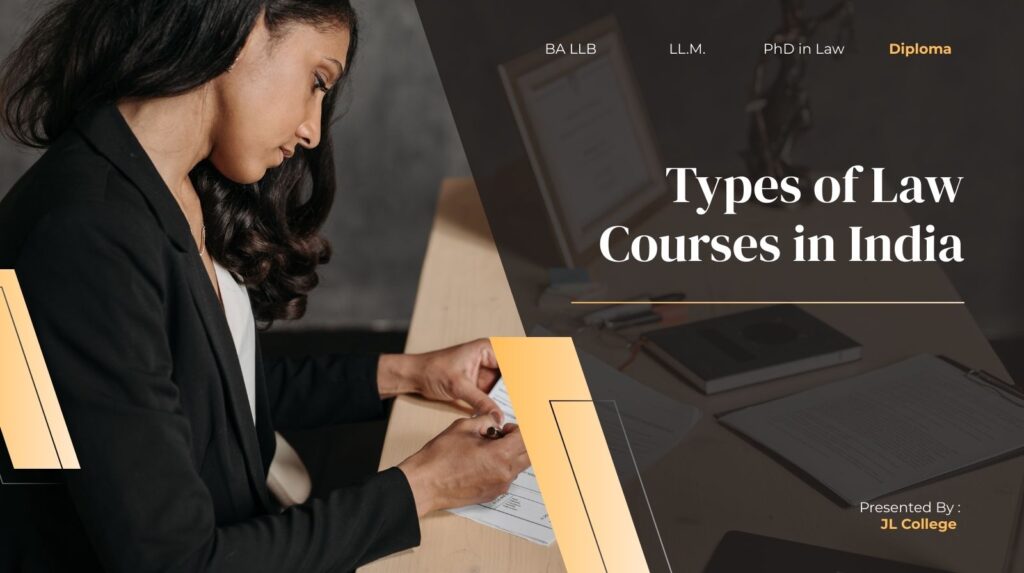
Types of Law Courses Available in India
In India, legal education is offered at multiple levels:
- Undergraduate Degrees (UG): 5-year integrated programs and 3-year LL.B.
- Postgraduate Degrees (PG): 1-year or 2-year LL.M. programs.
- Doctoral Programs: Ph.D. in Law.
- Diploma & Certificate Courses: Short-term specialized courses.
3-Year LL.B. Course
The 3-year LL.B. is a traditional law degree pursued after completing a bachelor’s degree in any discipline.
- Structure & Duration: It is a 3-year, six-semester program focusing exclusively on legal subjects.
- Eligibility: Candidates must have a Bachelor’s degree (in any stream) from a recognized university with a minimum percentage (usually 45-50% for General category). There is no upper age limit as per the latest BCI rules.
- Who is it for? It is ideal for graduates who decide to pursue law after their initial degree.
Source: Bar Council of India Rules on Legal Education.
5-Year Integrated Law Courses
These are the most popular law courses after 12th. Students can enter directly after higher secondary education.
- Duration: 5 years (ten semesters).
- Format: Integrates a foundational arts/commerce/science/management degree with a law degree.
- Common Types:
- BA LL.B.: Most common, combines Arts subjects like Political Science, Economics, Sociology with Law.
- BBA LL.B.: Focuses on Business Administration and Management principles alongside Law.
- B.Com LL.B.: Integrates Commerce and Accounting studies with Law.
- B.Sc LL.B.: Combines scientific streams (like Computer Science) with Law.
- Eligibility: Class 12 pass from a recognized board with minimum marks (often 45% for SC/ST and 50% for others for many NLUs). Entrance exams like CLAT, AILET, LSAT—India are mandatory for most reputed universities.
Source: Consortium of NLUs for CLAT.
Master of Laws (LL.M.)
An LL.M. is a postgraduate law degree for specialization.
- 1-Year vs. 2-Year Format:
- 1-Year LL.M.: Offered by many premier institutes (like NLUs, IITs, private universities) and requires a 5-year integrated LL.B. or a 3-year LL.B. degree.
- 2-Year LL.M.: Traditionally offered by many Indian universities. The BCI has shown preference for the 2-year structure for better depth, and many universities are transitioning.
- Eligibility: A recognized LL.B. degree (3-year or 5-year).
- Purpose: Allows lawyers to specialize in fields like Constitutional Law, Corporate Law, Intellectual Property Rights, etc.
Source: University Grants Commission (UGC) & respective university guidelines.
Specialized Diploma & Certificate Law Courses
These are short-term programs for skill enhancement or specialization for lawyers, law students, and professionals.
- Duration: 6 months to 1 year.
- Mode: Often offered in part-time, distance (where allowed), or online formats.
- Popular Specializations:
- Diploma in Cyber Law
- Diploma in Tax Law
- Diploma in Corporate Law & Management
- Certificate Course in Human Rights Law
- Diploma in Intellectual Property Rights (IPR)
- Offered by: Law schools, UGC-recognized institutions, and specialized bodies like the Indian Law Institute (ILI).
Source: Indian Law Institute course listings.
PhD in Law
It is the highest academic degree in the field of law.
- Eligibility: Typically requires an LL.M. degree with a good academic record (often a minimum of 55% marks).
- Duration: Minimum 3 years, which can extend to 5-6 years.
- Research Scope: Involves original research, thesis submission, and viva-voce. Candidates can specialize in niche areas like Space Law, Environmental Jurisprudence, Feminist Legal Theory, etc.
Source: UGC Regulations on Minimum Standards for PhD.
Distance/Online Law Courses:
Important: The Bar Council of India (BCI) does not recognize any law degree obtained through distance or online mode for the purpose of enrollment as an advocate. Therefore, while you can pursue diplomas or certificates via distance learning, the qualifying degree (LL.B. or integrated LL.B.) must be obtained through regular, full-time classroom study from a BCI-approved institution.
Source: BCI notification on distance/online legal education.
High-Demand Law Specializations in India
- Corporate & Commercial Law: For careers in law firms, M&A, banking.
- Criminal Law: For litigation, prosecution, defense.
- Cyber Law & Data Privacy: Growing field with the digitalization of commerce and crime.
- Intellectual Property Law (IPR): Focus on patents, trademarks, copyrights.
- Constitutional & Administrative Law: For public policy, PILs, judicial services.
- Tax Law: Direct and indirect tax litigation and advisory.
- International Law & Arbitration: For cross-border disputes and trade.
Why Do Indian Law Courses Differ in Duration & Structure?
The variation exists to cater to different entry points and career goals.
- 5-Year Integrated Courses: Designed for early induction, saving a year compared to (3-year graduation + 3-year LL.B.), and building interdisciplinary knowledge.
- 3-Year LL.B.: Caters to career changers or those who discover their interest in law later.
- LL.M. Formats: The 1-year vs. 2-year debate centers on depth of study, with BCI leaning towards the 2-year model for comprehensive specialization.
Latest Changes & Updates by BCI
The BCI periodically updates norms. Recent key points include:
- Removal of the upper age limit for appearing in CLAT and joining law courses.
- Emphasis on transitioning LL.M. programs to a 2-year model.
- Stricter approval processes for new law colleges to maintain standards.
- Discussion on introducing a national-level bar exam after law graduation for enrollment (similar to foreign jurisdictions).
Source: Bar Council of India press releases and notifications.
Summary Table of All Law Course Types
| Course Type | Duration | Eligibility | Governing Body | Key Purpose |
|---|---|---|---|---|
| 5-Year Integrated (BA/BBA/B.Com LL.B) | 5 Years | Class 12th + Entrance Exam | BCI | Primary law degree for students after 12th |
| 3-Year LL.B. | 3 Years | Any Bachelor’s Degree + Entrance Exam | BCI | Law degree for graduates |
| LL.M. (PG) | 1 or 2 Years | LL.B. Degree | BCI/UGC | Specialization in a law field |
| PhD (Doctorate) | Min. 3 Years | LL.M. Degree | UGC/University | Academic research & teaching |
| Diploma/Certificate | 6 mo – 1 Yr | Varies (often graduation) | University/Institution | Skill enhancement in niche area |
Frequently Asked Questions
What are the main types of law degrees in India after 12th?
The primary option is the 5-year integrated law course (e.g., BA LL.B., BBA LL.B.) offered through national or state-level entrance exams.
Can I do LLB through distance education?
No. The BCI does not recognize distance or online mode for LL.B. degrees for advocate enrollment. The degree must be full-time and regular.
What is the difference between a 1-year and 2-year LL.M.?
The 1-year LL.M. is intensive, often preferred by those with clear specialization goals. The 2-year LL.M. is more comprehensive and is increasingly becoming the standard model preferred by the BCI.
Which law specialization has the highest salary?
Corporate Law, Investment Banking Law, and Intellectual Property Law (in top law firms) are typically among the highest-paying specializations in India.
Is a 3-year LL.B. or a 5-year LL.B. better?
Both are equivalent for practice. The 5-year course is more holistic for students sure about law after school. The 3-year course offers a faster route for graduates.
The landscape of legal education in India is diverse and structured, offering multiple pathways—5-year integrated courses, 3-year LL.B., LL.M., PhDs, and diplomas. The key is to choose a path aligned with your career stage, interests, and the Bar Council of India’s regulations. Always ensure your chosen college and program are approved by the BCI for a successful career in law. Research thoroughly, prepare for entrance exams, and select a specialization that matches the evolving demands of the legal profession.