Bhogali Bihu, widely known as Magh Bihu, is the harvest festival that occupies a central place in the cultural life of Assam. Observed in the month of Magh according to the traditional Assamese lunar calendar (usually mid-January in the Gregorian calendar), Bhogali Bihu is a time of feasting, community gatherings, and ritual fires that mark the successful completion of paddy harvest and the beginning of a restful season for farmers. The festival’s atmosphere is defined by communal meals, temporary structures called bhelaghar, bonfires called meji, and an outpouring of traditional foods, dances, and games that celebrate abundance and social harmony.
Bhogali Bihu is one of the three Bihus that structure Assam’s agrarian calendar. Together with Rongali (Bohag) Bihu in spring and Kati (Kongali) Bihu in autumn, Bhogali completes a cycle that ties local religious practice, community identity, and agricultural rhythms into a continuous cultural tradition.
Meaning & Etymology
The name Bhogali derives from the Assamese word bhog, which means enjoyment or feasting. The epithet highlights the festival’s defining characteristic: communal indulgence in food and hospitality after months of hard agricultural labour. The alternative name Magh Bihu simply indicates the month — Magh — during which the festival is celebrated. In this sense, both names capture the twofold spirit of the occasion: seasonal timing (Magh) and celebratory feasting (Bhog).
Culturally, the names underline two interlinked values: gratitude for a successful harvest and the social aim of sharing that bounty with the entire village or neighbourhood. The festivals’ rituals and communal meals are therefore expressions of both economic sufficiency and social cohesion.
Historical Background
The origins of Bhogali Bihu are deeply embedded in Assam’s agrarian past. The festival has evolved from pre-modern farming practices in which seasonal markers and ritual acts served practical agricultural purposes — from thanking deities to marking storage of grain and organising post-harvest labour. Some scholars trace elements of the festival to Tibeto-Burman cultural practices as well as to local Austroasiatic and Indo-Aryan influences; these cultural strands merged over centuries to create the uniquely Assamese Bihu complex.
Historically, bonfires and offerings to the fire deity, the construction of temporary huts, and the collective cooking of pithas (rice cakes) were ways for communities to ritually close the harvest season. Fire rituals (symbolised by the meji) also reflect older forms of fire-worship and purification rites that many agrarian societies practised to ensure fertility and protection for fields and livestock.
When Is Bhogali Bihu Celebrated?
Bhogali Bihu is observed in the month of Magh. Celebration centres on two main moments: Uruka, the eve or night before the main Bihu day, and Magh Bihu day itself (typically falling on 14 or 15 January, although the precise date can shift with the lunar-solar calendar). Uruka is the night of feasting and socialising; the next morning, communities perform the meji rituals and conclude the festival.
Because Bhogali Bihu marks the end of harvesting, it aligns with many harvest festivals across India, such as Pongal in Tamil Nadu, Lohri in Punjab and Makar Sankranti in other parts of the country. While the cultural specifics differ, these festivals share agricultural timing and themes of gratitude, feasting and social reciprocity.
Importance of Bhogali Bihu
Bhogali Bihu’s importance is both material and symbolic. Economically, it marks the moment when fields have been harvested, and grains are stored — a practical turning point in the farming year that brings temporary prosperity and food security. Socially, the festival is a powerful vehicle for community bonding: villages and neighbourhoods organise collective feasts and reciprocal visits, which reaffirm kinship ties and social networks. Spiritually, the festival serves as a ritual of thanksgiving and purification that reaffirms human dependence on natural cycles and the broader environment.
Traditions & Rituals
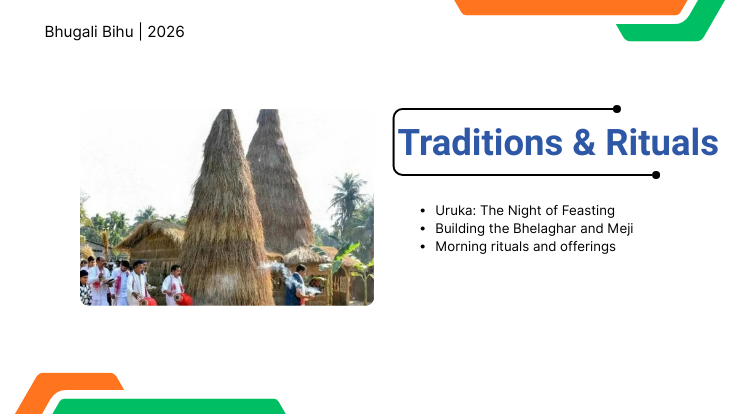
Uruka: The Night of Feasting
The most lively phase of Bhogali Bihu is Uruka, the eve before Bihu day. Families and neighbourhood groups gather near fields or riverbanks where they erect temporary thatched huts known as bhelaghar (or bhelghar). Food is prepared collectively — rice cakes, sweets and meat dishes — and the mood is festive with songs, dance and storytelling. The bhelaghar functions as a communal kitchen and sleeping shelter for groups celebrating the night together.
Building the Bhelaghar and Meji
Materials for the bhelaghar and the meji — typically bamboo, hay, straw and banana stems — are drawn from the harvest residue itself. Constructing these temporary structures is both practical and ritualistic: they are used for overnight hospitality and then consumed by the bonfire the next morning. The meji – a larger, ceremonial bonfire built the morning after Uruka — is central to the ritual life of Magh Bihu. People gather around the meji to offer pithas, betel nut, rice and symbolic offerings before lighting it as an act of thanks and purification.
Morning rituals and offerings
At dawn on Magh Bihu day, it is customary for households and neighbourhood groups to take part in prayers at the meji, to offer the prepared foods, and to ask for blessings for the coming year. After the burning, ashes may be distributed to fields, symbolically returning fertility to the soil. Visits to elders, distribution of leftover food and singing of traditional Bihu songs often punctuate the morning.
Food & Cuisine of Bhogali Bihu
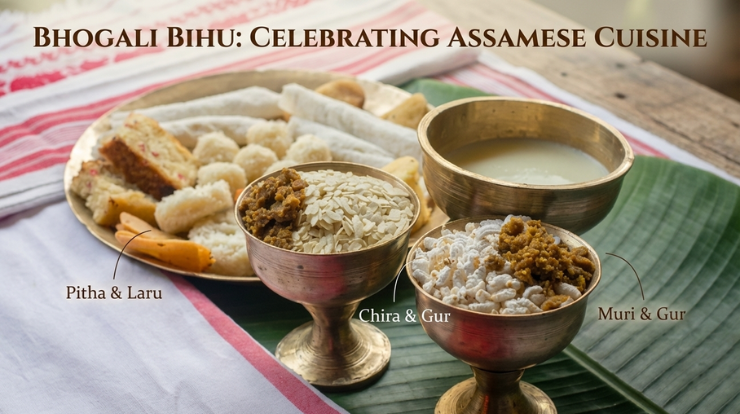
Food is the heart of Bhogali Bihu, and the festival is often described simply as the ‘festival of feasting’. Assam’s distinctive rice-based cuisine is on full display, with a variety of pitha (rice cakes), laru (sweets), savoury dishes and preparations cooked over open fires or in bamboo. Common festival foods include:
- Til pitha and sunga pitha (sesame- or coconut-filled rice cakes; sunga pitha is cooked inside bamboo).
- Laru — small sweet balls made of sesame or coconut mixed with jaggery.
- Doi-chira — flattened rice served with curd and jaggery.
- Other rice and fish/meat dishes, depending on local preferences.
The sharing of food during Uruka, the communal feasts, and the distribution of pithas among neighbours all reinforce Bhogali Bihu’s social message of abundance and generosity.
Games, Sports & Folk Activities
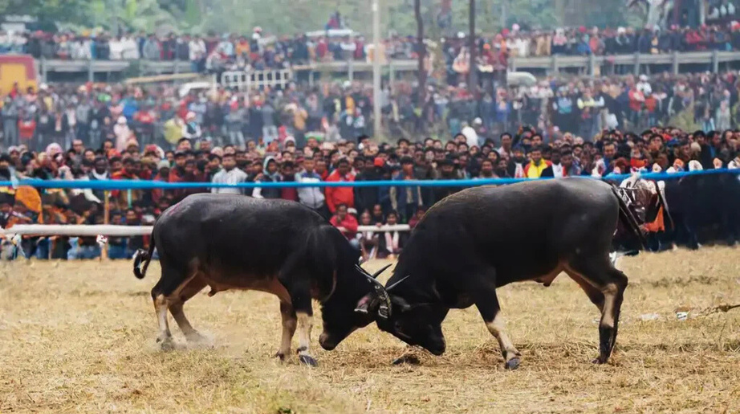
Bhogali Bihu has traditionally featured folk games, sporting events and competitions that add a playful, communal energy to the celebration. Children and adults take part in pot-breaking games such as tekeli bhonga, rope-walking, wrestling displays and other local contests. In some regions, buffalo fights and similar spectacles were historically part of the festivities; however, such events are subject to modern legal and welfare regulations and have been reduced or discontinued in many places. Contemporary community fairs and cultural programmes now often include folk music, dance and staged performances of traditional arts.
Bhogali Bihu in Modern Times
As Assam has urbanised and lifestyles have shifted away from purely agrarian rhythms, Bhogali Bihu has adapted. Urban communities celebrate Uruka nights in community halls or civic spaces instead of open fields; the traditional construction of bhelaghar in cities is often symbolic. Concerns for environmental protection and fire safety have also encouraged eco-friendly practices: smaller, controlled bonfires, the use of fewer non-biodegradable materials, and organised community events replacing informal large-scale burning. Social media and diaspora networks have taken the festival online, enabling Assamese people worldwide to share greetings, recipes and virtual events. Despite change, the festival’s core themes of gratitude, food-sharing and community continue to define it.
Regional Variations in Assam
Although Bhogali Bihu’s central rituals are shared across Assam, local customs and emphases vary:
- In Upper Assam, strong village-level participation and preservation of agrarian ceremonial forms are common.
- Lower Assam often features larger community gatherings and greater inclusion of various tribal and non-tribal traditions.
- Barak Valley displays its own cultural inflexions in food choices, songs and event organisation.
These regional differences reflect Assam’s ethnic and linguistic diversity but do not alter the festival’s essential identity as a harvest celebration.
Religious & Spiritual Aspects
While generally secular and communal in tone, Bhogali Bihu contains religious and spiritual elements connected to nature worship and gratitude. The act of offering prepared food and burning the meji can be read as an offering to Agni (fire) and to spirits associated with land and harvest. The rites and songs that accompany the festival often include invocations for future fertility, well-being and protection of crops — motifs shared with harvest festivals across the Indian subcontinent. Yet Bhogali Bihu is not narrowly sectarian: it is practised across communities as a shared cultural rite.
Bhogali Bihu vs Other Bihus
Comparing Bhogali Bihu with the other two Bihus clarifies how seasonal needs shape cultural expression:
- Rongali (Bohag) Bihu — celebrated in April; associated with sowing, new year festivities, youth dances and fertility rites.
- Kati (Kongali) Bihu — observed in October/November; more sober in tone, it marks a lean period when households pray for the protection of stored grain.
- Bhogali (Magh) Bihu — joyful and communal, it celebrates abundance after the harvest.
Each Bihu corresponds to a distinct agricultural phase and imparts a different mood to Assam’s cultural calendar.
Global Celebration
As Assamese people have migrated within India and abroad, they have taken Bhogali Bihu with them. Diaspora communities in major Indian cities and in countries such as the United States, United Kingdom and Gulf nations host Uruka nights, cultural programmes, and communal feasts to keep the tradition alive. These events are important for cultural continuity; they also adapt local elements — for instance, using community halls instead of open fields or dressing the festival with contemporary music and staged performances.
Cultural Significance Today
Bhogali Bihu remains a powerful symbol of Assamese identity. Its continuing vitality depends on intergenerational transmission: schools, cultural organisations, and media coverage help younger people learn songs, recipes and rituals. At the same time, festival practices are evolving to reflect modern sensibilities — more attention to animal welfare, environmental safety and public order — while preserving the core values of sharing and gratitude that define the festival. Government cultural programmes and local NGOs frequently support such efforts to preserve the intangible heritage of Bhogali Bihu.
Frequently Asked Questions (FAQs)
Q: Why is Bhogali Bihu called Magh Bihu?
A: It is observed in the Assamese month of Magh, and therefore, the festival is commonly called Magh Bihu. The term Bhogali highlights the festival’s emphasis on feasting.
Q: What is Uruka?
A: Uruka is the eve of Magh Bihu, when communities gather for overnight feasts in temporary bhelaghar structures. The next morning they perform meji rituals.
Q: What traditional foods are associated with Bhogali Bihu?
A: Common festival foods include pitha varieties (til pitha, sunga pitha), laru, doi-chira, and many rice-based dishes often shared communally.
Q: Is Bhogali Bihu a harvest festival?
A: Yes. Bhogali Bihu marks the end of the harvest season and is celebrated as a festival of abundance.
Bhogali Bihu (Magh Bihu) is a living expression of Assam’s agrarian history, community values and cultural creativity. Rooted in seasonal cycles and shaped by centuries of cultural exchange, it celebrates not only agricultural abundance but also the social bonds that sustain rural life. As Assam modernises, the festival adapts; yet the ritual of sharing food, lighting the meji, and joining with neighbours in song and dance remains central. Nurturing these practices today helps safeguard a rich cultural legacy for future generations.
Sources & Further Reading
- Magh Bihu — Wikipedia.
- Fairs and Festivals — Government of Assam (Culture portal).
- Bihu: The Festival of Assam — Sahapedia.
- Magh Bihu celebrated with fervour — Assam Tribune (coverage of rituals and Meji).
- Magh Bihu — Britannica (overview and context).
- Magh Bihu 2025: Date, Rituals, Celebration and Significance — Indian Express / Times of India (date calculations and modern coverage).